Restoration of a Keith Sonnier
Neon Work from the 1960s
Untitled (ca. 1968) is one of the first neon sculptures by the American artist Keith Sonnier (1941-202). Two neon tubes, one horizontal and one vertical, interact with two incandescent mirrored bulbs and each other, forming a loop which one tube pierces in a poetic and playful manner.
At some point in storage, the two neon tubes which make up the work’s major sculptural impact had shattered. I consulted with the artist’s estate and a neon fabricator to recreate the broken glass tubes and allow the work to be shown for the first time in nearly five decades.
Initial Condition
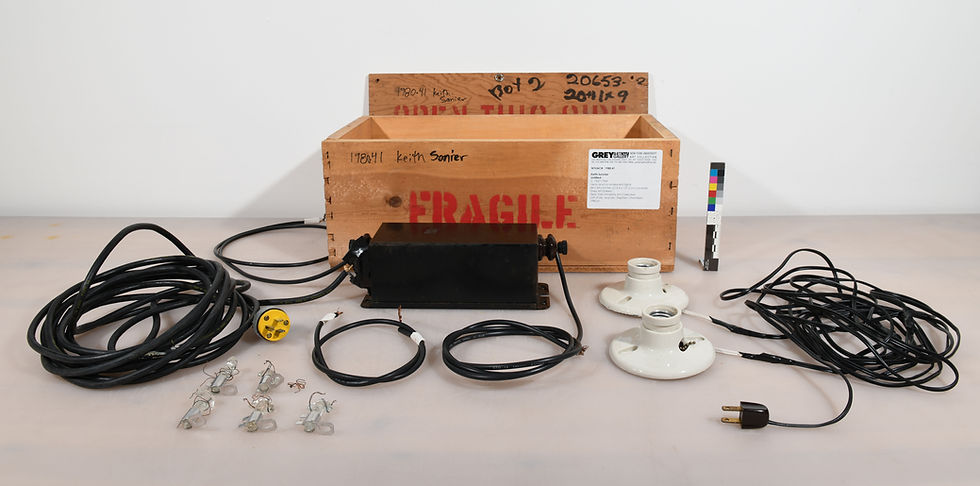
When what remained of the sculpture - a wooden box containing wires, sockets, and an old transformer - arrived to the conservation studio, its form was impossible to ascertain. Only once we were provided the black and white archival image did we have an idea of how the sculpture originally appeared.

Determining the Sculpture's Original Colors
The black and white archival image provided by the collector doesn’t reveal one of the most important qualities: its color(s).
The artist’s estate advised us that, given Sonnier's working tendencies at the time, the two tubes were once red and blue. The horizontal tube wrapping around both incandescent bulbs was probably red, and the vertical one was probably blue. The studio posited that the dark spots on vertical tube may come from argon (which burns blue), which can be “fiddly”, whereas neon (which burns red) is consistently bright. Thus, it was suggested that the vertical tube with dark spots was probably argon (blue).
Verifying the palette required performing a grayscale analysis on a standard color wheel and comparing those tones to the archival photo. With this step, I was able to confirm the studio’s hypothesis regarding the specific red and blue hues.
Completed Treatment
The successful restoration of this Keith Sonnier work underscores the critical value of meticulous planning and comprehensive documentation in contemporary art conservation. By synthesizing archival evidence with specialized fabrication knowledge, we ensured the work remains faithful to the artist's original intent. This project serves as a definitive case study in navigating complex stakeholder requirements to preserve artistic legacy for future generations.


CAD Work and Refabrication
To begin the reconstruction, I produced a life-size CAD schematic based on the historical photograph. This blueprint allowed for the creation of intricate copper mock-ups, which acted as precise physical templates. These forms were then sent to an expert neon fabricator in upstate New York familiar with Sonnier’s historic fabrication methods. The artist’s estate advised us on the tube diameter and original archival drawings stored in the neon studio helped inform our next steps.

After Treatment
2023 Version
The studio gratefully acknowledges the contribution of Reinhard Bek of Bek & Frohnert and Litebrite Neon Studio in Kingston, NY.
Archival Image, ca. 1969
After Treatment, 2023
After Treatment