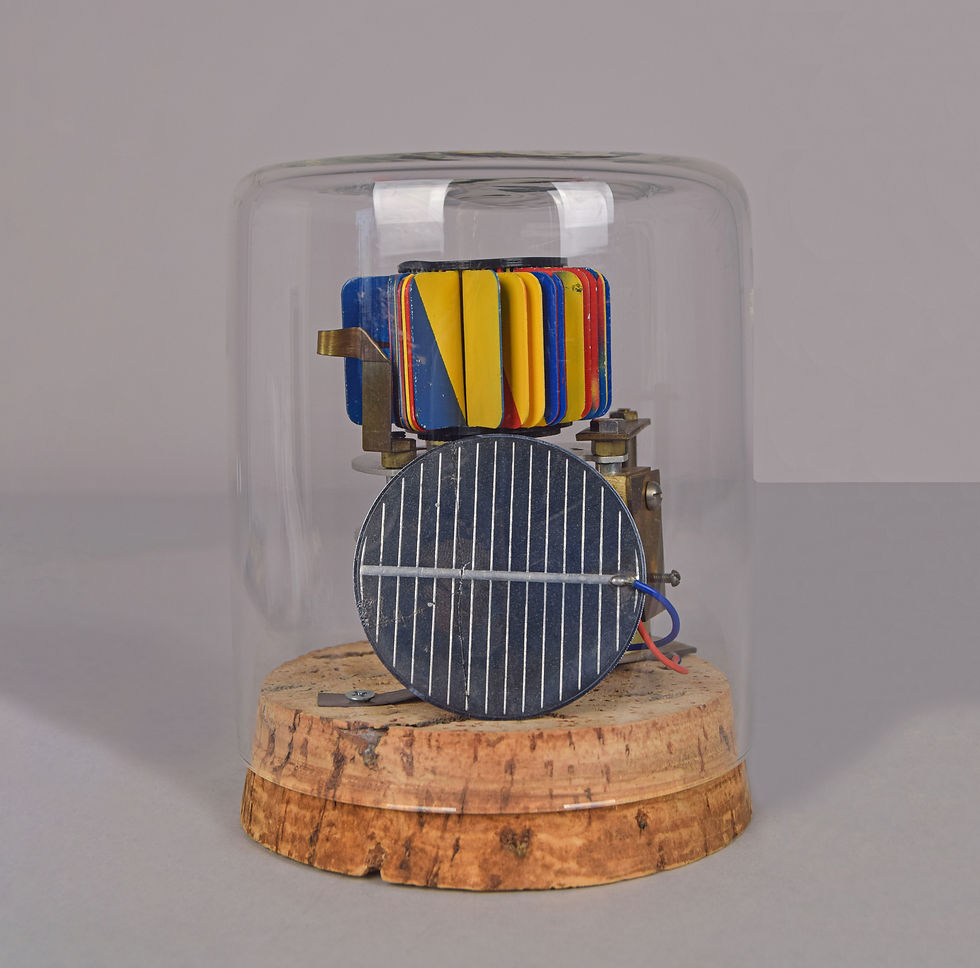
After Treatment

When Kinetics Become Relics:
Conservation of a Kinetic Work by Kiyoji Ōtsuji
When presented with a box of broken parts, the only indication that this small artwork ever moved was the presence of an electric motor and attached solar cell. The treatment presented obstacles which are often familiar to conservators of kinetic or time-based sculptures, challenging the concept of the work as a singular object and requiring collaborative decision-making to display it in a way which is faithful to the artist’s original intention.
Initial Condition
Of the 60 original plastic “fans,” 19 had had broken and detached from the drum, and 1 was missing. Our own sensory observations, aided by Fourier-transform infrared spectroscopy (FTIR) , indicated that the fans were painted plastic (most likely polyethylene terephthalate [PET]).
I began the process of recreating the replacements for the broken and missing fans by transferring the dimensions of the fans in 1:1 scale into a CAD drawing. They were then cut from 0.02” styrene, a relatively stable and “non-malignant” plastic. Later, they were airbrushed to match the original colors and patterns as accurately as possible.

Before Treatment


Looking at the archival image, It was clear that the glass dome which once fit over the assemblage was missing. In addition, the top motor unit has detached from the cork base and the solar cell had fractured. Additionally, 19 of the original small “fans” which hung from the spinning drum had detached, and one was missing entirely.
Restoration of the "Fans"


Lastly, the replacement fans were carefully inserted into the original drum using tweezers. The order of the pattern was unknown, so I made a diagram of the paintings on the intact drums and, finding no discernible pattern, inserted the replacement drums using my best judgement.

As an added bonus, the fluorescence of the enamel paint and a small amount of dilute shellac added to each replacement fan helps future conservators differentiate which elements are original and which are modern reproductions.

Treatment Rationale

When a work of kinetic art no longer moves, and it cannot be restored to its original functional condition, you are faced with two principal options: you may either choose to replicate the piece or retire it altogether. In opting to retire the artwork, one may decide to preserve it as a relic, honoring its historical and artistic significance despite the loss of its mechanical movement. This was the option chosen for this object.
The missing glass dome, visible in the archival images, needed to be replaced. Knowing that this would be the component requiring the most collaboration and trust, as it was the factor least in my control, I knew that forging a good relationship with a talented glass artist was important. I provided Kevin Scanlan, a Brooklyn-based glass artist, with dimensioned CAD renderings to ensure the replacement dome fit perfectly.
Recreation of the Glass Dome


The treatment of this work highlights the power of collaboration in contemporary art conservation. By harnessing the capabilities of digital manufacturing and combining them with material understanding and art historical research, the sculpture is more legible and true to its original form. While it is no longer truly "kinetic", the work is more aligned with the artist’s intention and is able to be appreciated more holistically.
Completed Treatment

After Treatment
After Treatment
Adapted from Reinhard Bek, “A Question of KinEthics”
(2016, the Getty Conservation Institute)